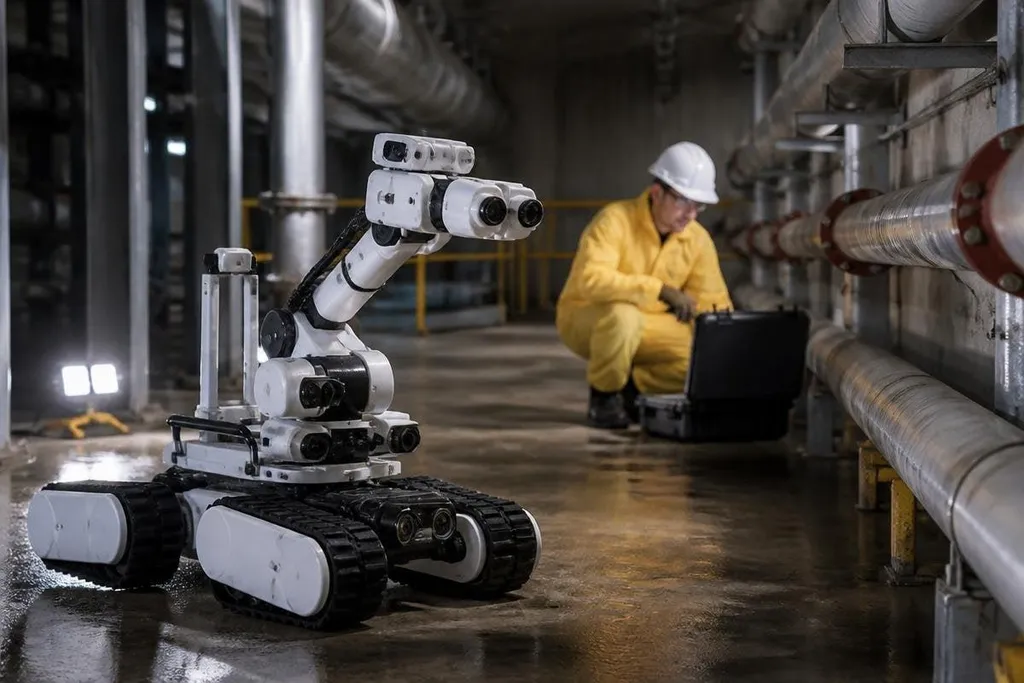
Nuclear sites already use robots where radiation, heat, contamination, or damaged structures put people at risk. The next step is giving those machines better sensing and more control while keeping a person responsible for the work.
- Remote machines can inspect, map, carry, and handle tools in places people should avoid.
- Teleoperation remains useful when conditions change faster than software can respond.
- The hard test is recovery after a sensor error, lost signal, or blocked route.
Where nuclear robots earn their place
A nuclear robot has a clear job when a person would need protective clothing, a limited stay, or a long route through a controlled area. Inspection is one example. A camera, radiation sensor, or LiDAR unit can collect information before a worker enters the area.
Handling tasks are harder. A robot may need to open a valve, move a sample, clear debris, or place a tool with limited visibility. The arm must control force as well as position, since a small mistake can damage equipment or spread contamination.
That work calls for more than a mobile base. The robot needs a manipulator, cameras that cope with poor visibility, a reliable communications link, and software that records what happened at each step.
Teleoperation will remain part of the system
Fully independent operation sounds useful in a nuclear site, but the setting changes too often for a fixed script to cover every case. A damaged pipe, a new obstruction, or a reading outside the expected range can make the next action unclear.
Teleoperation lets a trained worker guide the robot from a safer location. The operator can use video, force feedback, radiation readings, and a map of the work area to choose the next move. The robot handles balance and motor control while the person handles judgment.
Shared control sits between direct driving and independent action. Software can hold an arm inside a safe speed limit or stop movement near a restricted zone, while the operator still chooses the task. That division matters because it keeps the machine useful without giving software authority it has not earned.
Radiation changes the cost of a bad reading: an operator may need to enter a hot area to check what the robot missed. A nuclear robotics report should name the sensor, dose rate, test site, date, and measured result. Robot 24 is a place to start before the next section looks at why sensing remains the bottleneck.
Sensing is the real bottleneck
The site can confuse sensors in several ways. Dust can block a camera. Steel surfaces can affect radio signals. Radiation can damage electronics over time. Heat can change battery life and motor behavior.
The robot needs more than one source of information. Cameras show shape and color, LiDAR measures distance, inertial sensors track motion, and radiation sensors show whether the route is becoming unsafe.
The control system has to compare those inputs and flag a conflict instead of hiding it. That last part is easy to miss.
A robot that keeps moving with uncertain data can create more work for the response team. A robot that stops and reports the reason gives people a problem they can inspect.
What buyers should ask before a trial
A nuclear operator choosing a robot needs evidence from the work site, not a smooth demonstration in an empty room. These checks narrow the gap between a machine that moves and one that can support a real task:
- Task definition: name the object, tool, route, and acceptable result before selecting hardware.
- Radiation limits: record the tested dose range, expected service life, and parts that need replacement.
- Control mode: confirm when the system uses direct teleoperation, shared control, or independent movement.
- Signal loss: test what happens when video, command, or position data drops out.
- Recovery plan: require a safe way to stop, retrieve, clean, and inspect the robot after a fault.
- Data record: check that sensor readings, commands, alarms, and operator actions are stored for review.
I'd skip any system whose maker cannot explain how it fails when the link drops or the map becomes wrong. Nuclear work rewards predictable limits more than a long list of tasks.
The next nuclear robots will earn wider use by showing repeatable sensing, clear fault handling, and safe recovery in the places they were built to enter.